Venus is the second planet from the Sun. It is often called Earth’s “twin sister” because of their similar size and composition. The planet was named after the Roman goddess of beauty. Venus is the hottest planet in our solar system, mainly due to its thick atmosphere, which traps heat through an intense greenhouse effect.
Venus is sometimes visible from Earth, especially near the horizon at sunrise or sunset, and can be seen over the ocean or from high viewpoints. It is the second-largest rocky planet in our solar system.
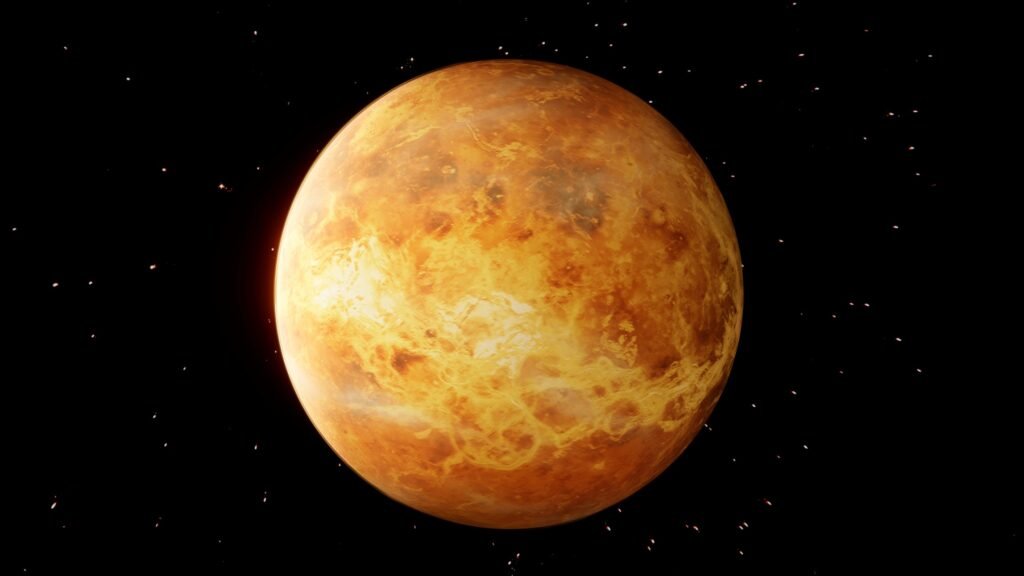
From space, Venus generally appears yellowish-white or yellowish-gray because of its thick cloud cover. However, images and observations from spacecraft show that the surface of Venus may be more of a rusty reddish-brown color, possibly due to the oxidation of volcanic rock. The planet is covered by a dense atmosphere made mostly of carbon dioxide, with clouds of sulfuric acid, which reflect a large amount of sunlight. This reflection makes Venus appear very bright and gives it its yellowish-white appearance from a distance.
When viewed through a telescope or in images that can penetrate the clouds, the surface appears rusty-brown or reddish-brown. This coloration is thought to be caused by the oxidation of iron-rich rocks, similar to how rust forms on Earth. Depending on the wavelengths of light used in imaging, the clouds can also reveal darker patterns and swirling motions. Some images show a yellowish or orange tint, especially in the lower parts of the atmosphere.
Venus does not have any moons. One possible reason is that the Sun’s strong gravitational pull in that region of the solar system may prevent Venus from capturing or holding onto a natural satellite, as any moon could become unstable and eventually crash into the planet or be pulled away by the Sun’s gravity.