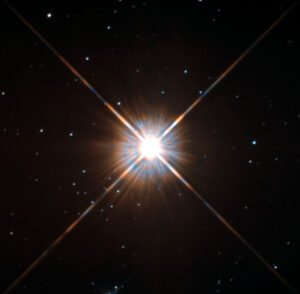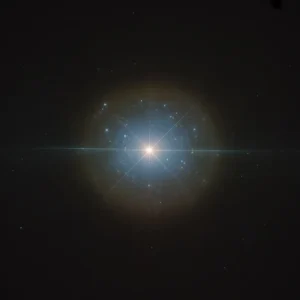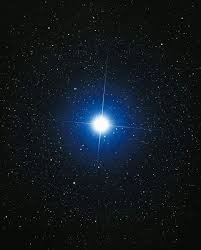
Vega is a bright blue-white star located about 25 light-years from Earth in the constellation Lyra. It has been studied for centuries and was once used as a standard reference for measuring other stars. The name Vega comes from the Arabic phrase an-nasr al-wāqiʻ, meaning “the Alighting Vulture.”
One of Vega’s most fascinating traits is its extreme rotation. Although it appears calm from Earth, Vega is actually spinning incredibly fast—around 175 km per second. This rapid spin causes the star to bulge at the equator and flatten at the poles, a shape known as an oblate spheroid. Because of this, Vega experiences gravity darkening, where its poles shine hotter and brighter than its cooler equator.
Vega is a main-sequence star, about three times more massive than the Sun, actively fusing hydrogen into helium. Surrounding it is a wide disk of dust and debris, likely formed by collisions between smaller celestial bodies. Despite this disk, astronomers have not found evidence of large gas planets around Vega, making it an ongoing subject of research. In about 12,000 years, Earth’s slow wobble will cause Vega to replace Polaris as the North Star. Vega also made history in 1850 as the first star, after the Sun, ever photographed through a telescope.