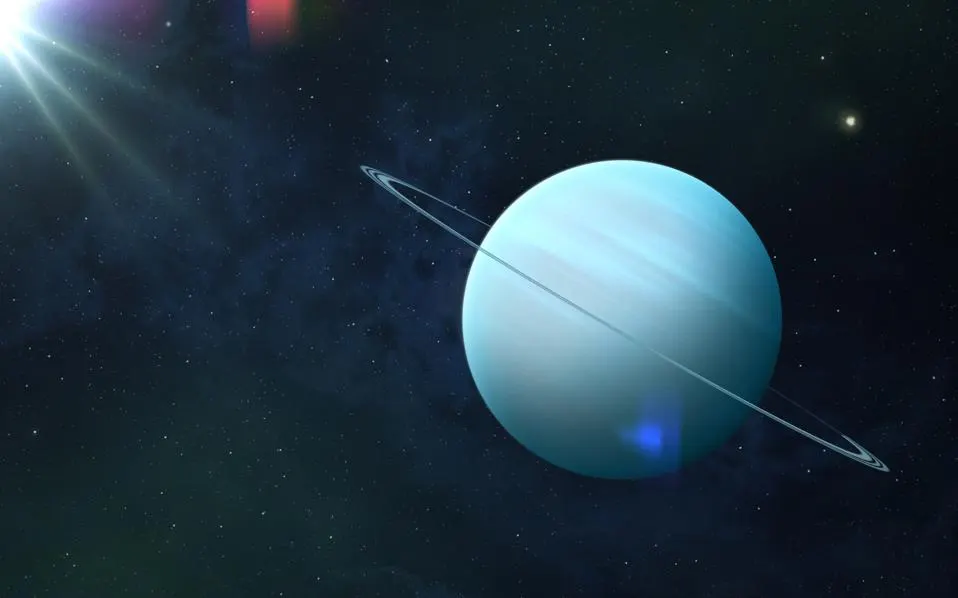
Uranus is the seventh planet from the Sun and is classified as a gaseous, cyan-colored ice giant. Most of the planet is composed of water, ammonia, and methane in a supercritical phase of matter, commonly referred to in astronomy as “ice” or volatiles. Uranus has a complex, layered cloud structure and holds the record for the lowest minimum temperature among all the planets in the Solar System—49 K (−224 °C; −371 °F).
Uranus has a pronounced axial tilt of 82.23°, which results in a retrograde rotation period of approximately 17 hours and 14 minutes. Due to this extreme tilt, each of Uranus’s poles experiences about 42 years of continuous sunlight followed by 42 years of darkness during its 84-Earth-year orbit around the Sun.
It is the third-largest planet by diameter and the fourth-largest by mass in the Solar System. According to current models, Uranus has a rocky core surrounded by a mantle of volatile ices, with an outer atmosphere primarily made of hydrogen and helium. Trace amounts of hydrocarbons (believed to be produced through photochemical reactions), as well as carbon monoxide and carbon dioxide (possibly delivered by comets), have also been detected in its upper atmosphere.
Several unexplained climate phenomena occur in Uranus’s atmosphere, including peak wind speeds of up to 900 km/h (560 mph), fluctuating polar caps, and irregular cloud formations. Notably, Uranus emits very little internal heat compared to the other gas giants, a mystery that remains unsolved.
Uranus has a system of dark rings that reflect only about 2% of incoming light, a strong and unusually tilted magnetosphere, and a total of 28 known natural satellites. These include 18 regular moons, with 13 being small inner moons, and 5 major moons—Miranda, Ariel, Umbriel, Titania, and Oberon. In addition, 10 irregular moons orbit at much greater distances. The planet’s magnetosphere is highly asymmetric and filled with charged particles, which may contribute to the darkening of its rings and moons.