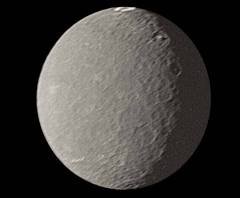
Umbriel is one of Uranus’s five major moons and stands out as the darkest, oldest-looking, and most heavily cratered of the group. Discovered in 1851 by British astronomer William Lassell, Umbriel was named after a shadowy gnome-like character from Alexander Pope’s poem The Rape of the Lock, a fitting inspiration for such a gloomy and enigmatic world. Its surface reflects very little sunlight, giving it a somber appearance that contrasts sharply with some of Uranus’s brighter moons.
Composed primarily of a mixture of water ice and rocky material, Umbriel appears to have experienced relatively little geological renewal compared to its neighbors. Its ancient surface is densely packed with impact craters of varying sizes, preserving a record of violent collisions from the early Solar System. While largely inactive today, Umbriel still displays intriguing features that hint at a more dynamic past, including deep troughs and canyons that cut across its surface.
One of Umbriel’s most fascinating features is the bright ring found within Wunda crater. This unusual deposit, possibly made of fresh ice or frozen carbon dioxide, stands out dramatically against the moon’s otherwise dark terrain and suggests that some form of internal or surface activity once occurred. Much of what scientists know about Umbriel comes from the brief but invaluable flyby of NASA’s Voyager 2 spacecraft in 1986, which revealed a world that is quiet, ancient, and mysterious. Umbriel remains a compelling reminder that even the darkest moons can hold remarkable secrets about planetary history and evolution.