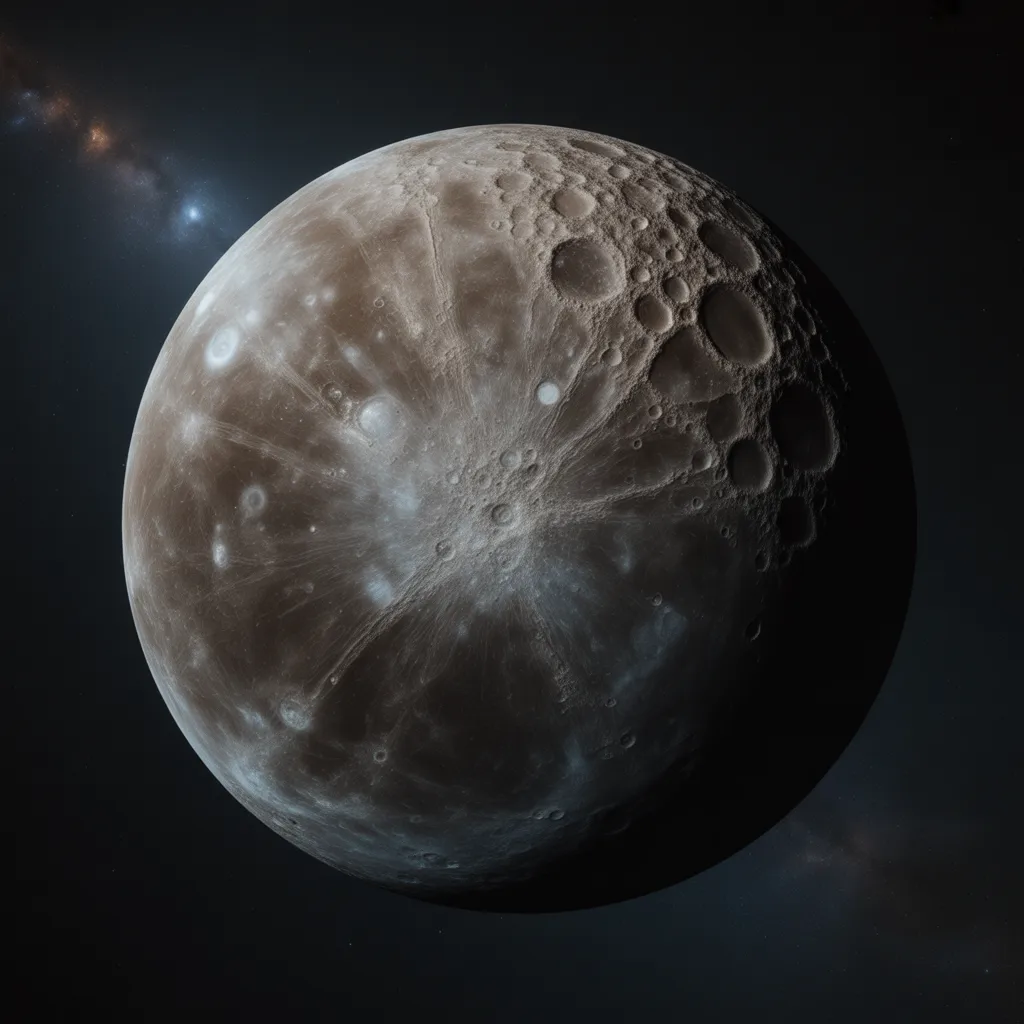
Titania is the largest moon of Uranus, discovered by William Herschel on January 11, 1787. It is named after the queen of the fairies in Shakespeare’s A Midsummer Night’s Dream. Titania’s surface is marked by a complex network of faults and valleys, evidence of past geological activity. It is the eighth-largest moon in the Solar System, with a diameter of about 1,578 km (981 miles). Titania appears to be composed of roughly equal parts rock and ice.
Its surface resembles that of Uranus’s moon Ariel, with a mixture of small impact craters and large canyons and fault systems. A prominent system of valleys extends for nearly 1,600 km (1,000 miles). Evidence from the Voyager 2 mission suggests that Titania was once geologically active, with tectonic extension causing fissures to open in its icy crust. Bright deposits—possibly frost—are visible on the sun-facing walls of some valleys.