The Moon, also known as Luna, is Earth’s only natural satellite. One widely accepted theory suggests that the Moon formed billions of years ago when a Mars-sized celestial body named Theia collided with the early Earth. The debris from this massive impact eventually came together to form the Moon we see today.
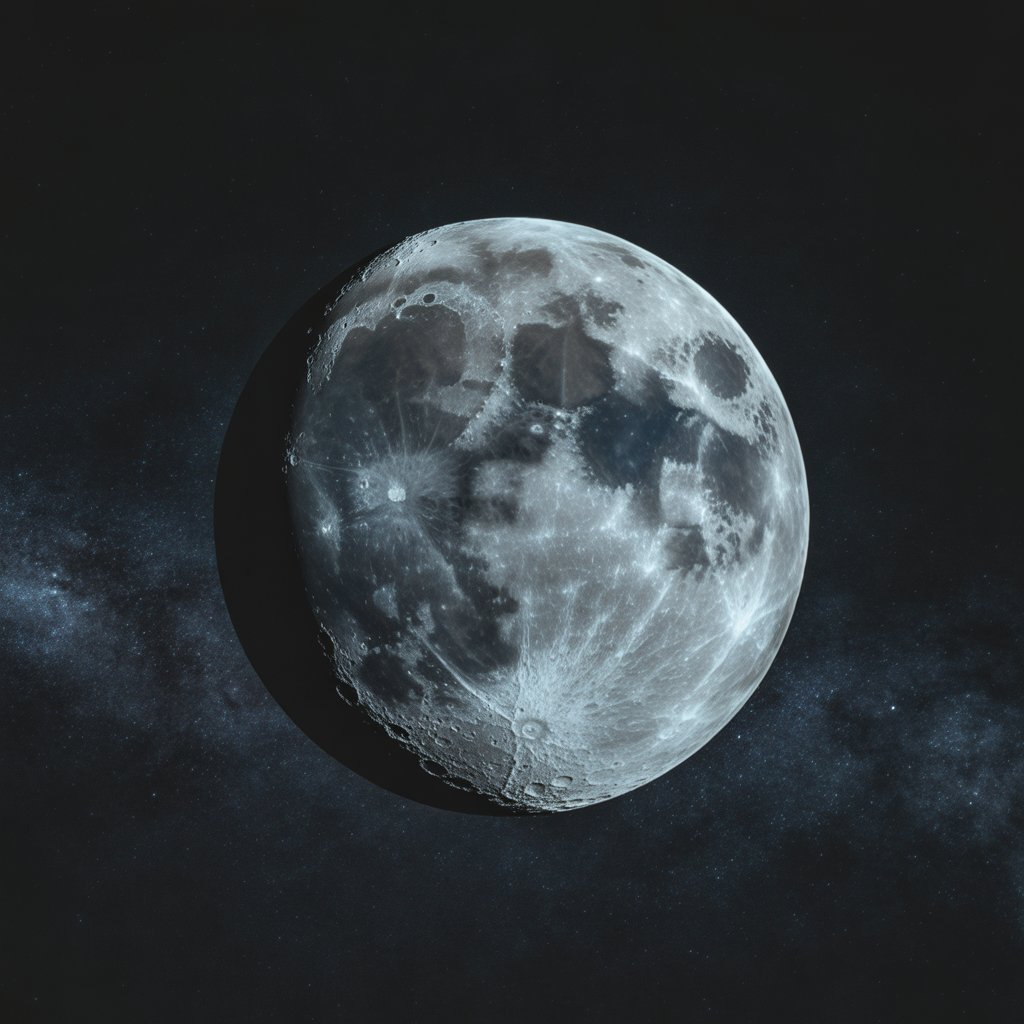
Unlike Earth, the Moon has no atmosphere, which means it cannot support life and experiences extreme temperature fluctuations. Its surface is covered in countless craters, created by asteroid and meteor impacts over billions of years. These craters act as a record of the Moon’s long and violent history.
In our solar system, the only object that shines with its own light is the Sun. Both Earth and the Moon are illuminated by sunlight, which always shines from the direction of the Sun. As the Moon orbits Earth, sunlight reflects off its surface, creating what we observe as moonlight. Depending on its position relative to Earth and the Sun, the Moon appears in different shapes—ranging from a full moon to a thin crescent, and sometimes it seems to disappear altogether. These changes are known as the phases of the Moon.
An eclipse occurs when the Earth, Moon, and Sun align in such a way that one body casts a shadow on another. In a solar eclipse, the Moon passes between Earth and the Sun, temporarily blocking sunlight from reaching Earth. In a lunar eclipse, Earth moves between the Sun and the Moon, casting its shadow on the Moon and darkening it.
One of the most exciting discoveries in lunar science is the presence of water. Ancient ice has been found deep in permanently shadowed craters, and H₂O molecules have also been detected on sunlit parts of the Moon. The search for water on the Moon began centuries ago, but only in recent decades have we confirmed its existence. This discovery is especially important for the future of human exploration and potential lunar settlements.
Just like Earth, the Moon has a day side and a night side, which shift as the Moon rotates. The Sun always illuminates half of the Moon, but how much of that illuminated half we see from Earth changes as the Moon moves along its orbit.