The name Kuiper is of Dutch origin and is an occupational surname meaning “cooper,” or barrel maker. In astronomy, however, the Kuiper Belt refers to a vast region of the outer solar system named after Dutch-American astronomer Gerard Kuiper, who theorized about the existence of such a zone, although he did not predict its current structure.
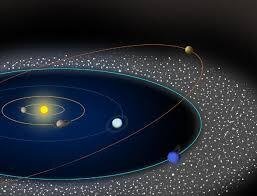
The Kuiper Belt lies beyond the orbit of Neptune, beginning at approximately 30 astronomical units (AU) from the Sun and extending outward to about 50 AU. Unlike the relatively flat and narrow asteroid belt between Mars and Jupiter, the Kuiper Belt is a thick, doughnut-shaped region encircling the Sun. It contains a large number of icy and rocky bodies that are remnants from the early formation of the solar system. These objects are thought to have remained relatively unchanged for billions of years, making the Kuiper Belt a valuable region for studying the history and evolution of our solar system.
The Kuiper Belt is home to a wide variety of celestial objects, ranging from small icy fragments to large dwarf planets. Pluto, once considered the ninth planet in our solar system, is the most well-known Kuiper Belt Object (KBO). In 2006, Pluto was reclassified as a dwarf planet due to its inability to clear its orbital path of other debris. Other significant KBOs include Haumea, known for its elongated shape and rapid rotation; Makemake, a bright dwarf planet with a methane-rich surface; Eris, which is slightly smaller than Pluto but more massive; and Arrokoth (previously known as 2014 MU69), a bilobed contact binary that provides clues about the early stages of planetesimal formation.
The Kuiper Belt is also believed to be the source of many short-period comets—those with orbital periods of less than 200 years. These comets are thought to originate from the outer parts of the Kuiper Belt and are occasionally drawn into the inner solar system by gravitational interactions with Neptune or other planetary bodies.
Our understanding of the Kuiper Belt took a significant leap forward with NASA’s New Horizons mission. Launched in 2006, New Horizons became the first spacecraft to visit this distant region. It conducted a historic flyby of Pluto and its moons in July 2015, capturing unprecedented images and data that revolutionized our view of the dwarf planet. The spacecraft then continued its journey deeper into the Kuiper Belt and, in January 2019, performed a successful flyby of Arrokoth. This encounter provided valuable information about the structure and composition of one of the most primitive bodies ever studied.
In summary, the Kuiper Belt is a fascinating and dynamic region of the solar system. It serves as a repository of ancient material, offering scientists a unique window into the processes that shaped the early solar system. Continued exploration and study of this distant zone will likely yield even more insights into our cosmic origins.