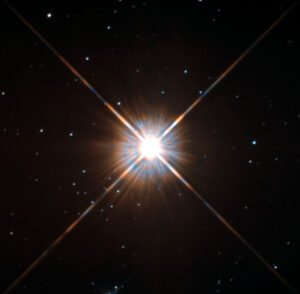
Sirius, commonly known as the Dog Star, is the brightest star visible in Earth’s night sky and lies in the constellation Canis Major (“Greater Dog”). Its remarkable brilliance is due to both its high intrinsic luminosity and its close proximity to Earth—just 8.6 light-years away, making it one of our nearest stellar neighbors.
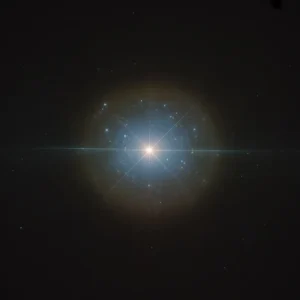
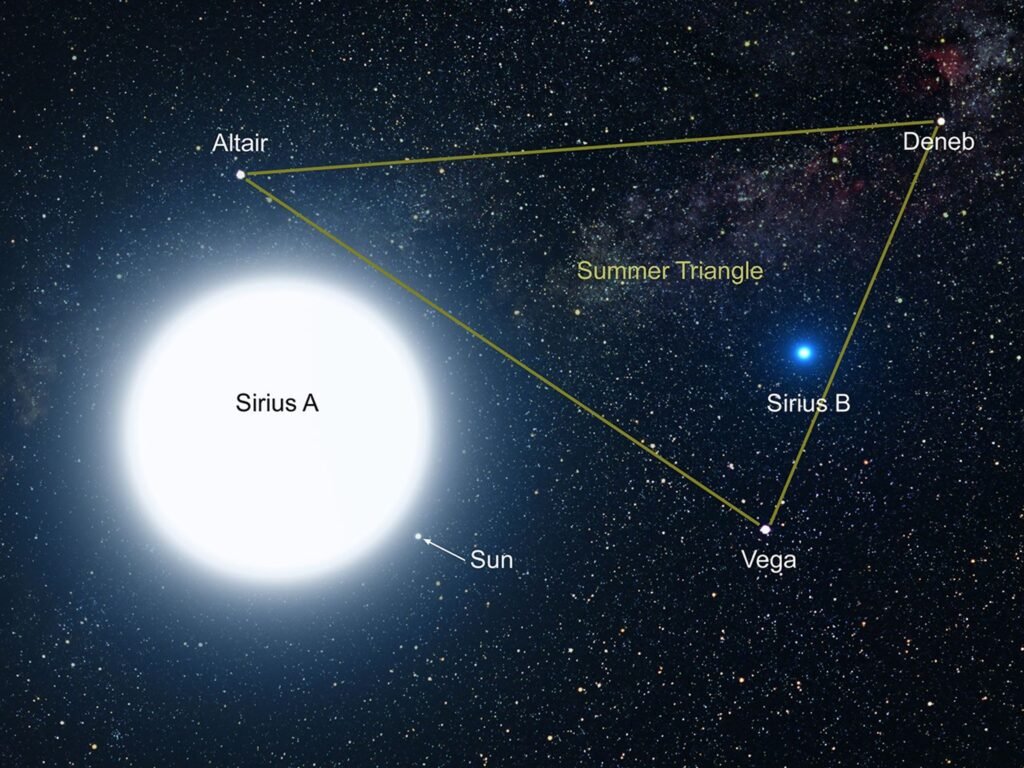
What appears to the naked eye as a single, radiant white star is actually a binary star system. It consists of Sirius A, a white main-sequence star about twice the mass of the Sun and roughly 25 times more luminous, and Sirius B, a faint but extremely dense white dwarf. Sirius B has a mass comparable to the Sun but a diameter similar to Earth’s, making it one of the most compact stars known.
The two stars orbit each other in an elliptical path with a period of about 50 years. The system is estimated to be approximately 230 million years old. Astronomical models indicate that Sirius B was once the more massive star, evolving rapidly into a red giant before shedding its outer layers and collapsing into its current white dwarf state.
Throughout history, Sirius has held immense cultural significance. Its name comes from the Greek Seirios, meaning “glowing” or “scorching.” In ancient Egypt, the heliacal rising of Sirius reliably signaled the annual flooding of the Nile, forming the foundation of their agricultural calendar. In ancient Greece and Rome, its appearance coincided with the hottest time of year, giving rise to the phrase “the dog days of summer.”
Today, Sirius remains a vital object of astronomical study, offering valuable insights into stellar evolution and white dwarf physics. Its intense twinkling and flashes of color near the horizon continue to make it one of the most captivating stars in the sky.