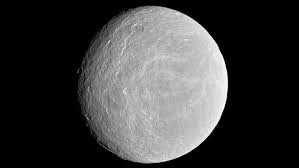
Rhea is Saturn’s second-largest moon and is approximately half the size of Earth’s Moon. It is primarily composed of water ice with a substantial rocky core, consisting of about three-quarters ice and one-quarter rock. Rhea has a very thin, tenuous atmosphere that contains only trace amounts of oxygen and carbon dioxide.
The surface is heavily cratered and features bright streaks, which are believed to be ice cliffs. Like Earth’s Moon, Rhea is tidally locked, meaning the same side always faces Saturn. Its surface temperatures are similar to those of Dione and Tethys—reaching around -281°F (-174°C) in sunlit areas and dropping to -364°F (-220°C) in shaded regions.
Rhea has a high albedo (reflectivity) due to its icy surface. Its leading hemisphere is more heavily cratered, while bright regions—often caused by impacts—reveal fresh water ice beneath the surface. The terrain also includes scarps, or jagged cliffs, which are large fractures in the moon’s crust.
Rhea was discovered by Giovanni Domenico Cassini on December 23, 1672. It is named after Rhea, the mother goddess and wife of the Titan Kronos in Greek mythology.