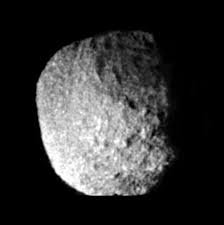
Proteus (Neptune VIII) is the second-largest moon of Neptune and the largest of its inner, regular satellites. It was discovered in 1989 by the Voyager 2 spacecraft and is an irregularly shaped, extremely dark body, lying just below the size threshold at which gravity would pull it into a spherical shape. Proteus has a heavily cratered surface and reflects only about 6 percent of the sunlight it receives, making it one of the darkest known objects in the solar system.
The moon is tidally locked to Neptune, always showing the same face to the planet as it completes an orbit every 26.9 hours at an average distance of about 117,647 kilometers (73,102 miles). Its most prominent feature is the massive impact crater Pharos, over 230 kilometers in diameter—more than half the moon’s total size. Proteus is composed primarily of ice mixed with rock and is thought to have formed from debris that re-accreted after Neptune captured its largest moon, Triton.