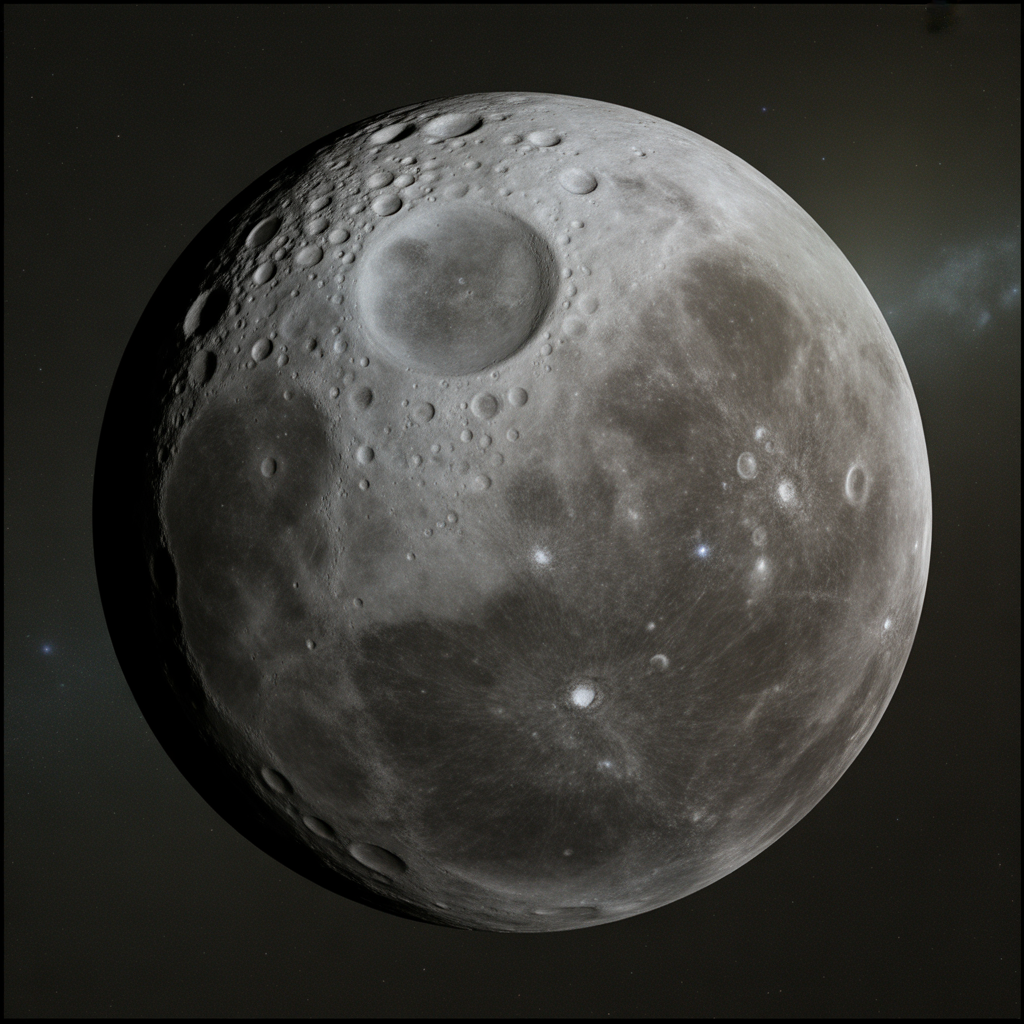
Oberon is Uranus’s second-largest and outermost of the planet’s five major moons. It was discovered in 1787 by William Herschel and named after the fairy king in William Shakespeare’s A Midsummer Night’s Dream. Oberon has a dark, slightly reddish surface that is heavily cratered, indicating an ancient landscape, with notable features such as central-peak craters (including Hamlet Crater), extensive canyons, and mountain ranges formed by past tectonic activity.
The moon is composed of roughly equal parts water ice and rock and may be partially differentiated into a rocky core and icy mantle. Some models suggest a possible subsurface ocean, though this remains uncertain and conditions are considered unfavorable for life. Oberon orbits Uranus once every ~13.5 days and, due to Uranus’s extreme axial tilt, spends much of its orbit outside the planet’s magnetosphere. Its old surface and internal structure provide valuable clues to the early formation and evolution of the Uranian satellite system, despite showing little to no present-day geological activity.