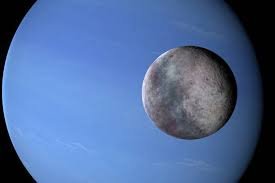
Triton is Neptune’s largest moon and is slightly larger than Pluto, distinguished by its unusual retrograde orbit, meaning it travels opposite Neptune’s rotation. Scientists believe Triton did not form alongside Neptune but was instead a captured dwarf planet from the Kuiper Belt. Its surface is dominated by ice and features smooth plains, pits, ridges, and dark streaks created by active cryovolcanic plumes, along with a bright south polar cap. Temperatures on Triton are extremely cold, averaging around −235°C (−391°F). Evidence suggests a subsurface liquid water ocean may exist beneath its icy crust, likely sustained by residual heat from radioactive decay. Triton also has a thin, hazy atmosphere composed mainly of nitrogen, capable of forming clouds and plumes, and its ongoing geological activity makes it one of the most dynamic and unique moons in the solar system.