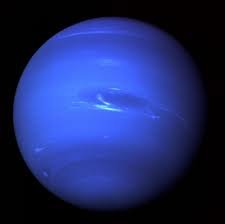
Neptune is the eighth and most distant known planet in our Solar System, named after the Roman god of the sea. It is classified as an ice giant, characterized by its deep blue color, extreme atmospheric winds, and faint ring system.
Neptune has 14 known moons, the largest of which is Triton. Triton is unique for its retrograde orbit, meaning it orbits Neptune in the opposite direction of the planet’s rotation—a rare phenomenon that suggests Triton may have been a captured object rather than having formed in place.
Unlike the other planets, Neptune is not visible to the unaided eye and holds the distinction of being the only planet discovered through mathematical prediction rather than direct observation. Irregularities in the orbit of Uranus led French astronomer Alexis Bouvard to propose the existence of an unknown planet affecting its path through gravitational pull.
After Bouvard’s death, his observations were used independently by John Couch Adams in England and Urbain Le Verrier in France to calculate Neptune’s predicted location. Their calculations led Johann Gottfried Galle to observe Neptune directly through a telescope on 23 September 1846, within one degree of Le Verrier’s prediction.
Triton was discovered shortly after Neptune’s identification, but the rest of its moons weren’t located until the 20th century. Neptune’s extreme winds—reaching speeds of over 2,000 km/h (1,200 mph)—and mysterious internal heat make it one of the most dynamic and least understood planets in the Solar System.