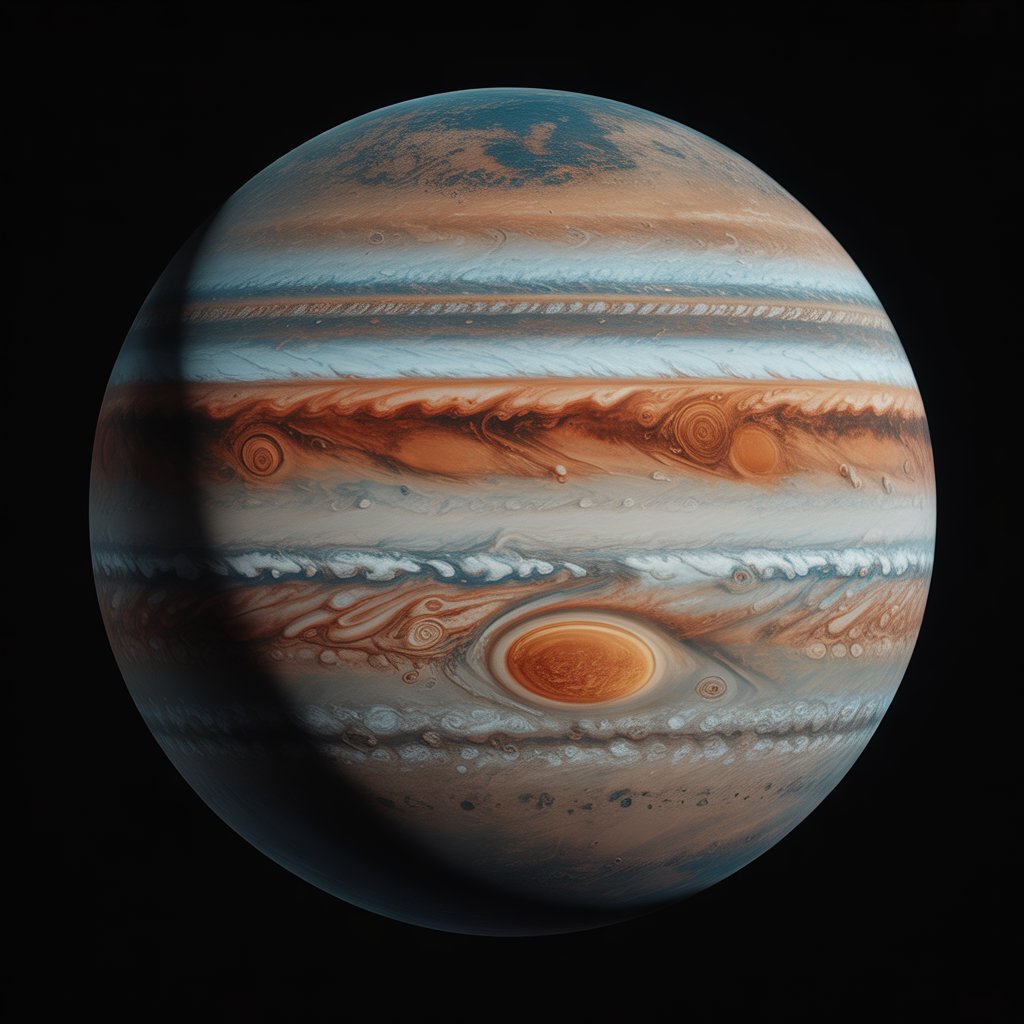
Jupiter is the fifth planet of our solar system. It is the oldest planet, as it was formed just after the Sun, nearly 4.6 billion years ago. Jupiter is the largest planet in our solar system and a gas giant primarily composed of hydrogen and helium. It is famous for its swirling cloud bands and the iconic Great Red Spot—a massive storm that has persisted for centuries.
Jupiter has 79 moons, including Ganymede, the largest moon in our solar system. Jupiter’s immense size, powerful magnetic field, and rapid rotation give it unique characteristics. Its colorful atmosphere displays stunning patterns created by ammonia and methane clouds. Jupiter’s gravity helps keep the asteroid belt in place and prevents many asteroids from escaping its gravitational influence. It also protects Earth by deflecting asteroids and comets coming from the outer solar system and the Oort Cloud.
Jupiter has been visited by many spacecraft, including Juno and Galileo. In both ancient Greek and Roman civilizations, Jupiter was named after the chief god of the divine pantheon: Zeus to the Greeks and Jupiter to the Romans. The International Astronomical Union formally adopted the name “Jupiter” for the planet in 1976 and has since named its newly discovered satellites after the god’s lovers, favorites, and descendants.
In Latin, Iovis is the genitive case of Iuppiter (i.e., Jupiter). It is associated with the etymology of Zeus, meaning “sky father.” The English equivalent, Jove, came into use as a poetic name for the planet around the 14th century.
Jovian is the adjectival form of Jupiter. The older form, jovial, used by astrologers in the Middle Ages, came to mean “happy” or “merry”—moods attributed to Jupiter’s influence in astrology. The original Greek deity Zeus also supplies the root zeno-, used in some Jupiter-related words such as zenography.