Tethys was discovered by Giovanni Domenico Cassini in 1684. It was named after a Titan from Greek mythology. Tethys is Saturn’s fifth-largest moon and orbits the planet at a distance of approximately 295,000 km (183,000 miles). Its orbital period is about 45 hours.
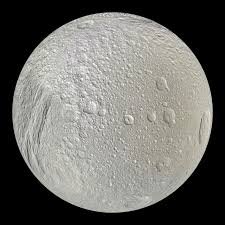
Tethys is primarily composed of water ice, with a small amount of rocky material. Its density is slightly less than that of water, indicating a composition dominated by ice. The moon’s surface is heavily cratered. The most prominent feature is the Odysseus impact crater, which spans nearly two-fifths the diameter of Tethys itself. Another major feature is Ithaca Chasma, a vast fissure that wraps around much of the moon’s circumference.
Tethys is accompanied by two smaller moons, Telesto and Calypso, which orbit near its Lagrangian points—60 degrees ahead and behind in its orbit. Being relatively close to Saturn, Tethys experiences tidal heating, which may have contributed to melting events and modifications of its early surface features.
The moon has a high albedo (reflectivity), suggesting a surface dominated by clean water ice. This is evident in the bright appearance of many of its crater floors. Tethys lacks a detectable atmosphere, leaving its surface exposed to the harsh environment of space.