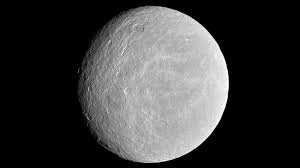
Dione has a diameter of about 697 miles (1,120 km). Its density indicates that roughly one-third of the moon is composed of a rocky silicate core, while the remaining two-thirds consist of water ice. The average surface temperature is approximately -304°F (-186°C), a condition under which ice behaves similarly to rock.
Dione’s surface features a mix of heavily cratered regions and more lightly cratered plains. One of its most distinctive features is the bright, linear “wispy terrain” on its trailing hemisphere—believed to be ice cliffs formed by tectonic fractures caused by Saturn’s tidal stresses. Another prominent geological structure is Padua Chasma, a large linear ridge.
Dione orbits Saturn approximately every 2.7 Earth days. It is accompanied by two smaller moons—Helene, which orbits 60° ahead, and Polydeuces, which orbits 60° behind. These moons occupy stable positions in Dione’s Lagrangian points, similar to Jupiter’s Trojan asteroids.
Dione was discovered in 1684 by Italian astronomer Giovanni Domenico Cassini. Centuries later, the Cassini spacecraft provided detailed images and data, greatly enhancing our understanding of Dione’s surface features and composition.