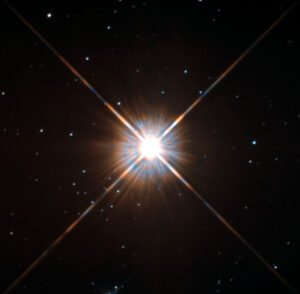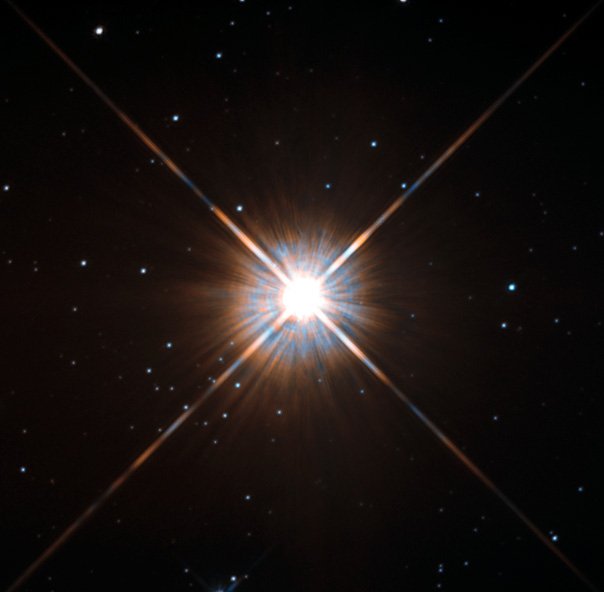
Proxima Centauri is the closest known star to our Solar System after the Sun. It lies about 4.246 light-years away from Earth in the southern constellation Centaurus. Even though it is our nearest stellar neighbor, the star is too faint to see with the naked eye, so astronomers need telescopes to observe it.
This small red star was discovered in 1915 by the Scottish astronomer Robert Innes at the Union Observatory. The name Proxima comes from Latin and means “nearest.” The star is actually part of the Alpha Centauri system, which also includes Alpha Centauri A and Alpha Centauri B. However, Proxima is extremely far from them—about 13,000 astronomical units (AU) away—and it takes around 550,000 years to orbit the pair once.
Compared to our Sun, Proxima Centauri is tiny. It has only about 12% of the Sun’s mass and about 15% of its size. Its surface temperature is about 3,050 Kelvin, which is much cooler than the Sun’s 5,778 Kelvin, giving it a reddish color. Because of this, it is classified as a red dwarf star.
Despite being small, Proxima is extremely active. It is known as a flare star, meaning it frequently releases powerful bursts of radiation. These stellar flares can suddenly increase the star’s brightness and produce strong X-ray and ultraviolet radiation. Scientists believe its powerful magnetic field covers most of its surface, making the star very stormy. Such activity could make it difficult for life to survive on planets nearby.
One of the most exciting things about Proxima Centauri is that it has planets orbiting it. In 2016, astronomers discovered Proxima Centauri b, an Earth-sized planet located in the star’s habitable zone, the region where liquid water might exist. However, this planet orbits extremely close to the star—only about 0.05 AU away—and completes an orbit in just 11.2 days.
Later discoveries revealed more possible planets. Proxima Centauri d, announced in 2022, is a very small planet orbiting even closer to the star with a period of 5.1 days. Another possible planet, Proxima Centauri c, may be a much larger world orbiting farther away, though scientists are still studying whether it truly exists.
Because Proxima Centauri is our closest stellar neighbor, scientists see it as an important target for future space exploration. One project called Breakthrough Starshot hopes to send tiny laser-powered spacecraft toward the star system in the future. Even then, reaching it would still be extremely difficult. For example, the famous spacecraft Voyager 1 would take over 70,000 years to reach Proxima at its current speed.
Even though it is small and faint, Proxima Centauri is one of the most important stars in astronomy. As the closest star to our Solar System, it could one day become humanity’s first destination beyond the Sun’s neighborhood.