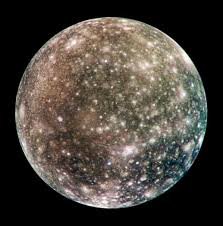
Callisto, once dismissed as a “boring” and “ugly duckling moon,” is now considered a potential host for alien life. Early scientists saw it as just a crater-covered hunk of rock and ice, with no signs of volcanic or tectonic activity. However, data from NASA’s Galileo spacecraft in the 1990s revealed a surprising possibility: Callisto may have a salty ocean beneath its icy crust.
This discovery pushed Callisto onto the list of places in our solar system that might harbor life. Evidence suggests that this subsurface ocean could be interacting with a rocky layer about 155 miles (250 kilometers) beneath the surface—key conditions for life. Additionally, oxygen has been detected in Callisto’s exosphere, another potential sign of habitability.
Callisto was discovered on January 7, 1610, by Italian astronomer Galileo Galilei, alongside Jupiter’s three other largest moons: Ganymede, Europa, and Io. It was named after Callisto, a woman from Greek mythology who was transformed into a bear by Zeus—the Greek equivalent of the Roman god Jupiter.
Callisto is Jupiter’s second-largest moon after Ganymede and the third-largest moon in the entire solar system. It’s nearly the same size as Mercury, with a circumference of about 9,410 miles (15,144 kilometers). It orbits Jupiter at a distance of about 1,170,000 miles (1,883,000 kilometers) and takes approximately 16.689 Earth days to complete one orbit. Like Earth’s Moon, Callisto is tidally locked, meaning the same side always faces Jupiter.
Callisto is about:
- 1.8 times farther from Jupiter than Ganymede
- 2.8 times farther than Europa
- 4.5 times farther than Io
Jupiter and its moons orbit the Sun at a distance of about 484 million miles (778 million kilometers), and it takes the Jovian system around 12 Earth years to complete one solar orbit.
Scientists believe that Callisto and Jupiter’s other moons formed from the disk of gas and dust left over after Jupiter’s formation. Callisto’s surface is icy and heavily cratered, featuring bowl-shaped craters and multiring impact structures. Despite its ancient, rugged appearance, Callisto’s hidden ocean makes it a fascinating candidate in the search for extraterrestrial life.