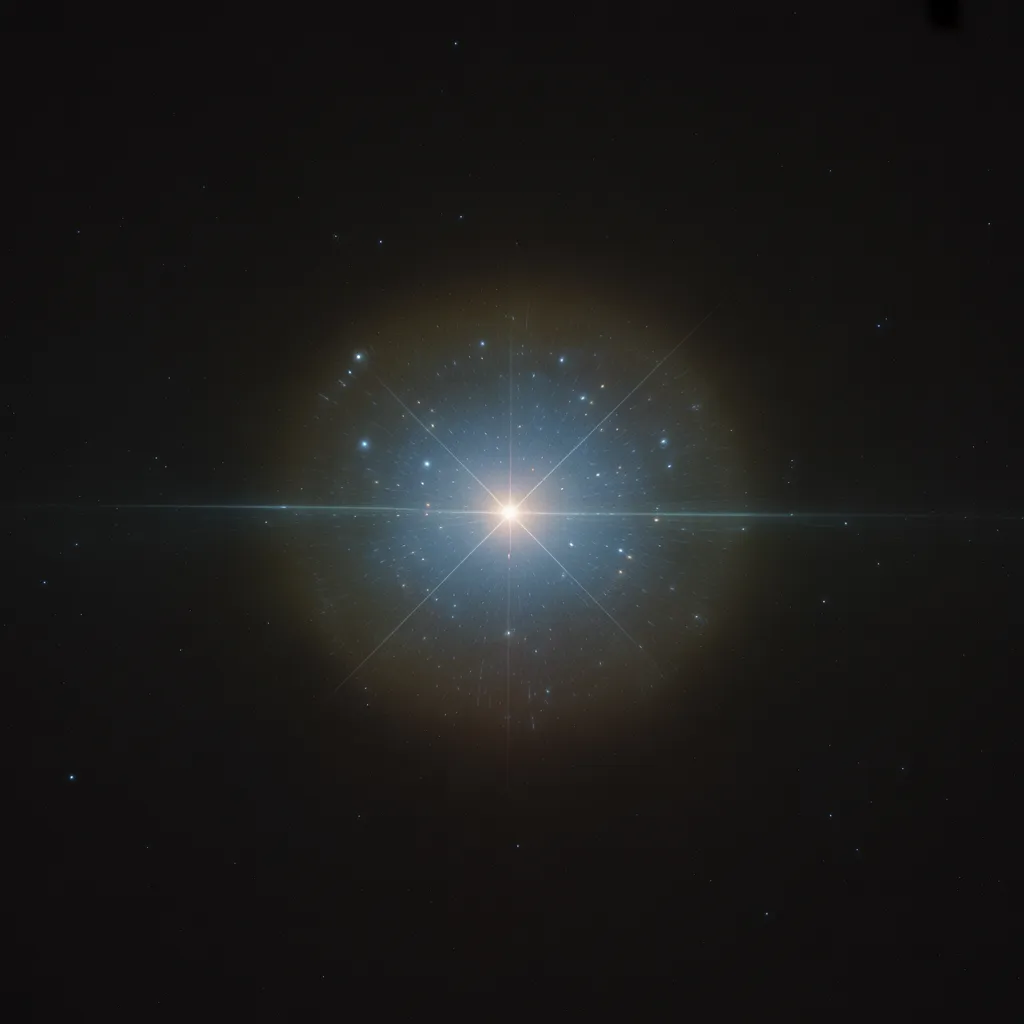
Altair, formally designated Alpha Aquilae (α Aql), is a remarkably bright A-type main-sequence star located approximately 16.7 light-years from Earth, making it one of the closest naked-eye stars to our solar system. It is the brightest star in the constellation Aquila (the Eagle) and the twelfth-brightest star in the night sky.
Altair is one of the three vertices of the Summer Triangle asterism, alongside Vega and Deneb, dominating the northern hemisphere’s summer and autumn skies.
The name Altair comes from the Arabic phrase al-nasr al-ṭā’ir, meaning “the flying eagle,” reflecting its position within the constellation’s imagery.
One of Altair’s most defining characteristics is its extremely rapid rotation. It spins at an equatorial velocity of about 286 km/s and completes one rotation in roughly 8.9 hours. This high speed causes the star to become significantly oblate—flattened at the poles and bulging at the equator. Its equatorial diameter is more than 20 percent larger than its polar diameter.
Because of this unusual shape, Altair became a major target for interferometric studies. In 2006–2007, astronomers using the CHARA Array successfully produced a resolved image of Altair’s surface—the first detailed image ever captured of a main-sequence star other than the Sun.
Altair is also classified as a Delta Scuti variable star, meaning its brightness varies slightly due to internal pulsations.
Culturally, Altair holds deep significance. In Chinese mythology, it represents Niulang, the cowherd in the romantic legend The Cowherd and the Weaver Girl. Separated from his beloved (represented by Vega) by the Milky Way, their reunion is celebrated during China’s Qixi Festival and Japan’s Tanabata festival.
Altair is currently passing through the G-cloud, an interstellar cloud of gas and dust, and is considered relatively young, with an estimated age of about 100 million years.