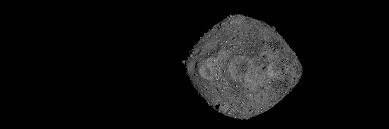
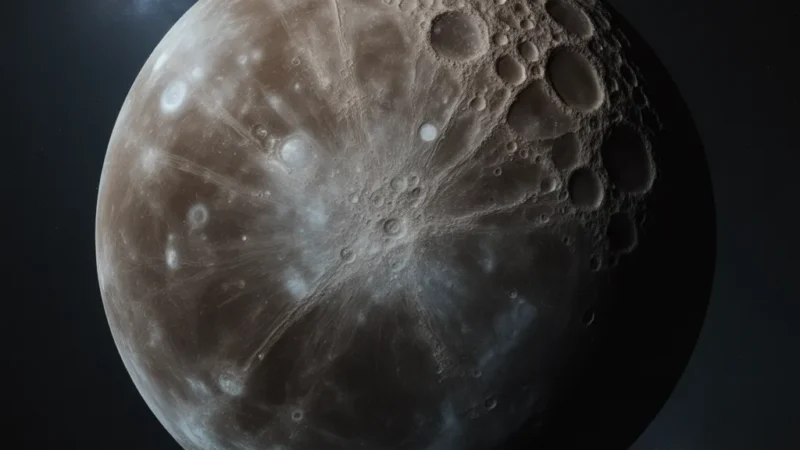
Paaliaq: Saturn’s Irregular Red Moon from the Inuit Group
Paaliaq is an irregular, prograde moon of Saturn, known for its light red coloration and an estimated diameter of approximately 22 kilometers. Discovered in October 2000, it is part of the Inuit group of moons, which are believed to have formed from the…
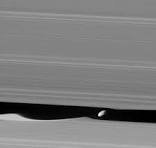
Daphnis: Saturn’s Shepherd Moon Creating Ring Waves
Daphnis is a small, football-shaped moon of Saturn, discovered in 2005. It orbits within the Keeler Gap, a narrow opening in Saturn’s A ring. Due to its gravitational influence, Daphnis disturbs nearby ring particles, generating distinctive wave-like…
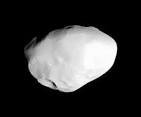
Telesto: Saturn’s Smooth Trojan Moon at Tethys’ Lagrange Point
Telesto is a small, icy moon of Saturn with a mean radius of about 12.4 km, making it one of the planet’s tiny moons. It shares Tethys’ orbit and resides at a Lagrange point (L4)—specifically, 60 degrees ahead of Tethys in its path around Saturn.…
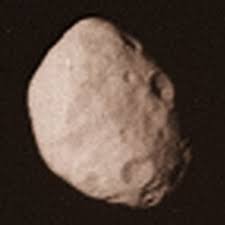
Janus and Epimetheus: Saturn’s Orbit-Swapping Twin Moons
Janus and Epimetheus are two of Saturn’s moons that share the same orbit, separated by only about 50 kilometers (31 miles). When they approach each other, they exchange momentum and switch orbits—the inner moon becomes the outer, and vice versa. This…
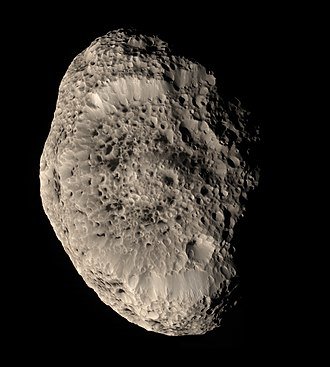
Hyperion: Chaotic Moon of Saturn with Unique Shape
Hyperion is notably irregular in shape, not conforming to a spherical form, which is why it’s described as potato-shaped. Its low density—estimated to be about half that of water—is due to its high porosity, meaning it is approximately 42% empty…
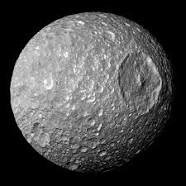
Mimas: Saturn’s Cratered, Icy, Synchronous, Oceanic, Low-Density, Mysterious Inner Moon
Mimas was discovered by William Herschel on September 17, 1789. It is best known for its enormous impact crater, Herschel, whose central peak gives the moon a resemblance to the Death Star from Star Wars. Composed primarily of water ice, Mimas has a low…
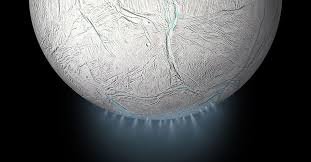
Enceladus Geysers Reveal Subsurface Ocean and Potential Life
Enceladus has active geysers that spew water vapor and ice particles from its south polar region into space. These plumes are a key indicator of a subsurface ocean beneath its icy shell. Scientists believe this ocean is in contact with a rocky core,…
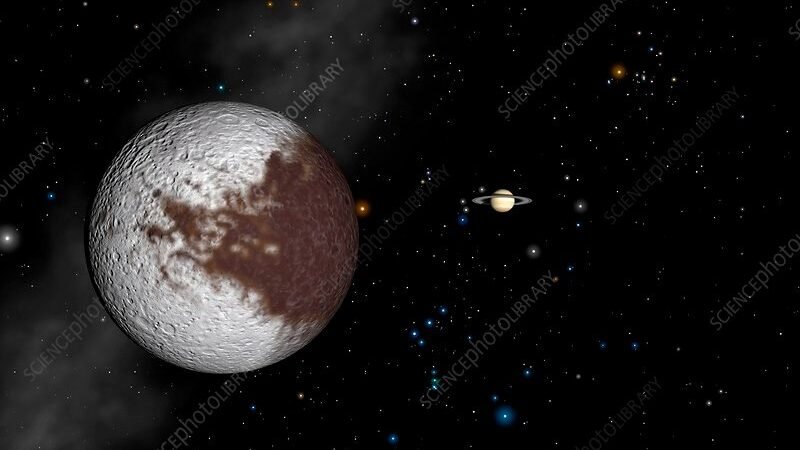
Iapetus: Saturn’s Two-Toned Moon with Equatorial Ridge
Iapetus was first discovered by Giovanni Domenico Cassini in 1671. One of its hemispheres is very dark, reflecting only about 5% of sunlight, while the other is bright, reflecting nearly 50%. The dark material is believed to be composed of carbon-rich…
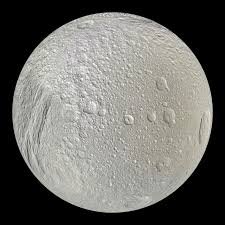
Facts About Tethys: Saturn’s Icy Moon and Craters
Tethys was discovered by Giovanni Domenico Cassini in 1684. It was named after a Titan from Greek mythology. Tethys is Saturn’s fifth-largest moon and orbits the planet at a distance of approximately 295,000 km (183,000 miles). Its orbital period…
Dione: Saturn’s Icy Moon with Tectonic Cliffs and Trojan Companions
Dione has a diameter of about 697 miles (1,120 km). Its density indicates that roughly one-third of the moon is composed of a rocky silicate core, while the remaining two-thirds consist of water ice. The average surface temperature is approximately…