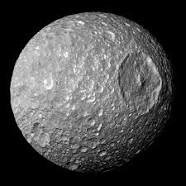
Mimas was discovered by William Herschel on September 17, 1789. It is best known for its enormous impact crater, Herschel, whose central peak gives the moon a resemblance to the Death Star from Star Wars. Composed primarily of water ice, Mimas has a low density and orbits Saturn synchronously, always showing the same face to the planet. Scientists theorize that Mimas may have played a role in forming the Cassini Division—a prominent gap in Saturn’s rings. Recent data suggests that a young, global subsurface ocean may exist beneath its heavily cratered surface, likely maintained by tidal forces from Saturn and orbital resonances with nearby moons such as Enceladus and Tethys.
Top Stories
Mimas: Saturn’s Cratered, Icy, Synchronous, Oceanic, Low-Density, Mysterious Inner Moon